

The Services a Modern Private Intelligence Firm Offers
Private intelligence and risk advisory firms, of the kind Pallas Intel Agency represents, typically offer a range of distinct but related services, each addressing a different category of risk or information need that clients in the corporate, legal, and financial sectors regularly encounter. Understanding these service lines in more depth clarifies what this kind of firm actually does day to day, well beyond the somewhat mysterious popular image the phrase ‘intelligence agency’ often conjures.
Geopolitical and Country Risk Analysis
For multinational companies and institutional investors, understanding political, economic, and security developments in the countries where they operate or invest is essential to sound decision-making, and this is often one of the most visible service lines a firm like Pallas provides. Geopolitical risk analysts track a wide range of indicators, including political stability, regulatory developments, civil unrest, sanctions regimes, and broader economic trends, synthesizing this information into structured reports and briefings that help corporate leadership and boards understand the risk environment surrounding a specific market, investment, or supply chain relationship.
This work typically draws on a combination of local media monitoring, government publications, academic and think tank research, and, importantly, a network of regional experts and, where firms maintain them, in-country contacts who can provide grounded, current context beyond what published sources alone can offer. The final product is usually less about predicting specific future events with certainty and more about helping clients understand a range of plausible scenarios and their associated risks, allowing for more informed strategic planning.
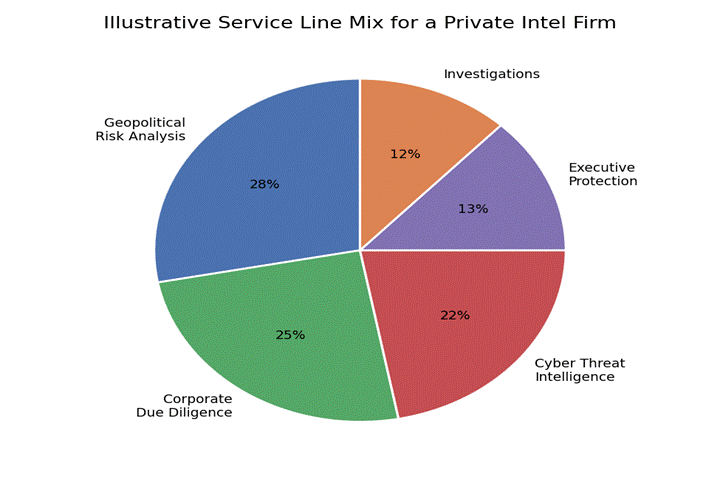
Figure 2: An illustrative breakdown of service lines typical of a private intelligence and risk advisory firm.
Corporate Due Diligence
Before entering into a major transaction, whether an acquisition, a significant new business partnership, or a large investment, companies frequently commission due diligence research to better understand the individuals and organizations they are considering doing business with. This work typically involves researching a target company’s corporate structure, beneficial ownership, litigation history, regulatory record, and the professional backgrounds and reputations of its key executives, drawing on public corporate registries, court records, media archives, and licensed commercial databases that aggregate this kind of information across jurisdictions.
Due diligence work has grown considerably in importance as anti-money laundering and anti-corruption regulations have expanded in many jurisdictions, creating both a compliance requirement and a genuine risk management incentive for companies to understand who they are actually transacting with, particularly in complex cross-border deals involving jurisdictions with less transparent corporate ownership disclosure requirements.
Cyber Threat Intelligence
As cyberattacks have become a persistent concern for organizations across virtually every industry, cyber threat intelligence has become an increasingly central service line for firms in this space. This work involves monitoring the tactics, infrastructure, and activity of cybercriminal groups and other threat actors relevant to a client’s industry or specific risk profile, often including monitoring of forums and marketplaces where stolen data or compromised access is bought and sold, in order to provide clients with early warning of emerging threats and, in some cases, direct evidence that their own data or systems have already been compromised.
Executive Protection and Investigations
Firms in this space frequently offer executive protection services, including threat assessments for corporate leaders who may face elevated personal risk, alongside more traditional investigative services such as fraud investigations, intellectual property theft investigations, and workplace misconduct inquiries. These engagements often combine investigative research methods with physical security expertise, reflecting the broad, cross-disciplinary skill set many private intelligence firms maintain across their staff.
Delivering Actionable Analysis, Not Just Raw Data
Across all of these service lines, what distinguishes a credible private intelligence firm from a firm that simply aggregates publicly available data is the quality of analysis and judgment applied to that raw information. Clients are generally not paying for information they could easily find themselves through a basic internet search; they are paying for the expertise to gather relevant information efficiently, evaluate its reliability, and synthesize it into clear, actionable conclusions and recommendations tailored to a specific business decision, a distinction that firms like Pallas generally emphasize heavily in how they describe their value to prospective clients.
Ongoing Monitoring Versus One-Time Engagements
Beyond discrete, project-based engagements such as a single due diligence report ahead of a specific transaction, many private intelligence firms also offer ongoing monitoring services, in which a client subscribes to continuous tracking of a particular risk area, whether a specific country’s political situation, a set of high-risk business relationships requiring periodic re-screening, or an evolving cyber threat relevant to the client’s industry. This shift toward recurring, subscription-style engagements has become an increasingly important part of many firms’ business models, offering more predictable revenue than one-off project work while also allowing analysts to build deeper, more current expertise on an ongoing account rather than starting largely from scratch with each new discrete engagement.
This model also tends to benefit clients directly, since a firm providing continuous monitoring of a given risk area is generally positioned to flag emerging developments more quickly than a client would identify independently, and can draw on the accumulated institutional knowledge built up over the course of a long-running monitoring relationship when a sudden, significant development requires rapid analysis and response.
Pricing Models Across Service Lines
Pricing structures across the industry vary considerably depending on the nature of the engagement. Discrete due diligence or investigative projects are often priced on a fixed-fee or capped hourly basis tied to a clearly defined scope of work, giving clients cost predictability for a well-bounded research question. Ongoing monitoring services, by contrast, are typically priced as a recurring subscription or retainer, reflecting the continuous nature of the work involved. The most senior, judgment-intensive advisory engagements, such as direct strategic counsel to an executive team navigating a specific crisis or major decision, are often billed at premium hourly or daily rates reflecting the specialized experience being deployed, a pricing structure similar in spirit to how elite legal or management consulting services are typically billed. Clients evaluating proposals from competing firms generally weigh this pricing structure alongside a firm’s track record and reputation, recognizing that the lowest-cost option is not necessarily the most cost-effective one once the quality and reliability of the resulting analysis is taken into account.