

How Pallas Approaches the Intelligence Cycle
Much of the methodology underlying private intelligence work, including the kind of work a firm like Pallas performs, is adapted from a framework long used in government intelligence services known as the intelligence cycle, a structured process for turning raw information into finished analysis useful for decision-making. While the specific sources and legal constraints differ considerably between government and private-sector intelligence work, the underlying analytical discipline of the intelligence cycle translates well into the private sector context, and understanding this framework offers useful insight into how rigorous private intelligence analysis is actually produced.
Planning and Direction
Every private intelligence engagement typically begins with a clear scoping conversation between the firm and the client, establishing precisely what business question or decision the requested analysis needs to support. This planning stage is more consequential than it might initially appear, since poorly scoped intelligence work risks producing a report that is technically accurate but not actually useful for the specific decision a client is facing. Experienced firms generally invest significant time in this initial stage, working with clients to clarify not just what information they are seeking but what decision that information will ultimately inform, since this context shapes which sources and analytical approaches will be most valuable.
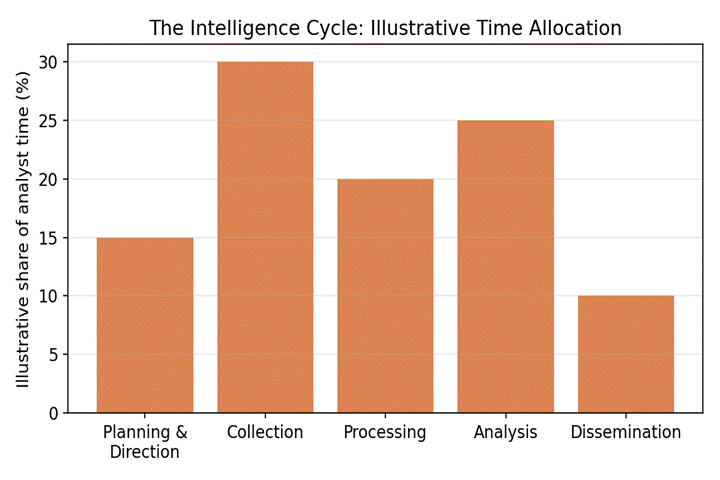
Figure 3: An illustrative breakdown of analyst time allocation across the stages of the intelligence cycle.
Collection
Once an engagement is scoped, analysts move into the collection stage, gathering relevant information from the range of lawful sources available to private firms. This typically includes open-source research across public records, media archives, corporate registries, and licensed commercial databases, supplemented in some cases by direct outreach to knowledgeable contacts who can provide additional context or verification. The collection stage requires careful judgment about source reliability, since not all available information is equally trustworthy, and experienced analysts develop a disciplined habit of tracking the provenance and reliability of each piece of information gathered, information that becomes important later when assessing overall confidence in the final analysis.
Processing and Analysis
Raw collected information generally requires significant processing before it becomes useful, including translation where relevant, organizing information from disparate sources into a coherent structure, and cross-referencing findings across multiple sources to identify corroboration or contradiction. The analysis stage that follows is where trained analysts synthesize processed information into actual conclusions, identifying patterns, assessing the reliability and significance of different findings, and, where appropriate, offering a structured assessment of confidence in the conclusions reached, a practice borrowed directly from government intelligence tradecraft, where analysts are trained to clearly communicate not just what they believe but how confident they are in that assessment and why.
This stage often involves structured analytical techniques designed to counteract common cognitive biases that can distort judgment, such as deliberately considering alternative explanations for available evidence or explicitly identifying what additional information, if it became available, would most change the analyst’s current assessment. These techniques, widely taught within government intelligence training programs, have increasingly been adopted by private-sector analytical teams seeking to bring similar rigor to their own work.
Dissemination
The final stage of the intelligence cycle involves communicating findings to the client in a format suited to their needs, whether a detailed written report, a concise executive briefing, or an ongoing monitoring feed for situations requiring continuous updates. Effective dissemination requires tailoring both the level of detail and the format of a final product to its intended audience; a report intended for a technical risk management team might include considerably more granular sourcing detail than a briefing prepared for a board of directors, who typically need clear, high-level conclusions and recommendations rather than the full underlying research trail.
A Continuous, Iterative Process
In practice, the intelligence cycle rarely proceeds in a perfectly linear fashion; new findings during the collection or analysis stages frequently prompt a return to earlier stages to refine the original research question or pursue newly identified lines of inquiry. Firms like Pallas generally treat the intelligence cycle less as a rigid sequential checklist and more as a disciplined analytical framework that helps ensure thoroughness and rigor throughout an engagement, regardless of how much back-and-forth the actual research process involves along the way.
Quality Control and Peer Review
Reputable private intelligence firms generally build formal quality control steps into their analytical process, often including a peer review stage in which a second, sometimes more senior, analyst reviews a colleague’s findings and reasoning before a final product is delivered to a client. This review process serves several purposes: it helps catch factual errors or unsupported logical leaps, it provides an important check against individual analyst bias or blind spots, and it helps maintain consistency in analytical rigor and confidence-level language across a firm’s various analysts and practice areas, ensuring that a client receives a comparably reliable standard of work regardless of which specific analyst or team handled a given engagement.
Some larger firms also maintain formal after-action review processes for significant engagements, revisiting completed analysis against how events actually unfolded in order to identify where the firm’s assessments proved accurate and where they fell short, a practice adapted directly from similar accuracy-tracking disciplines used within government intelligence services. This kind of structured self-assessment, while resource-intensive, is generally regarded within the industry as an important discipline for continuously improving analytical accuracy over time, rather than assuming that a firm’s existing methodology is beyond ongoing refinement.
Communicating Uncertainty Clearly
A distinctive discipline that private intelligence firms have generally adopted from government intelligence tradecraft is the deliberate, structured communication of uncertainty. Rather than presenting conclusions as simple, unqualified facts, well-trained analysts are taught to use consistent, calibrated language, such as clearly distinguishing between an assessment made with high confidence based on strong corroborating evidence and one made with only moderate confidence based on a single, unverified source, so that clients can weigh a given conclusion appropriately in their own decision-making rather than treating all analytical statements as equally certain. Firms that maintain this discipline consistently, even when a client might prefer a more definitive-sounding answer, are generally regarded within the industry as more trustworthy over the long term than firms that overstate their certainty to appear more authoritative in the moment.