

The Future of Private Intelligence: Trends Shaping the Industry
The private intelligence and risk advisory industry has changed considerably over the past decade, and several converging trends suggest continued significant evolution in how firms like Pallas Intel Agency will operate in the years ahead. Examining these trends offers a useful window into where this increasingly consequential corner of the corporate services industry appears to be headed.
The Rise of Open-Source Intelligence
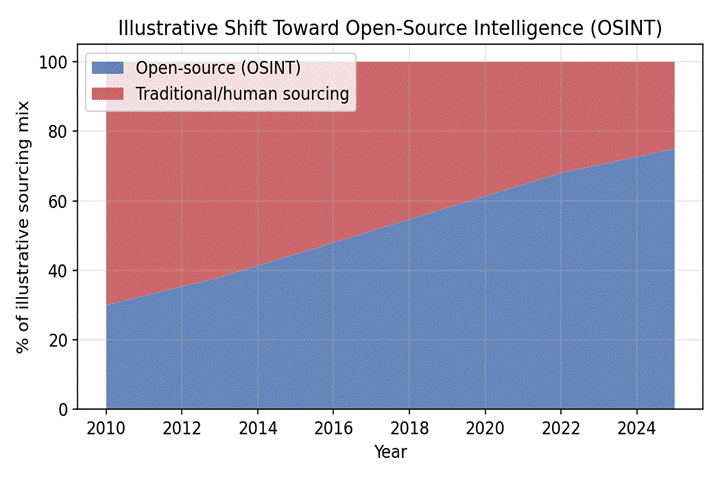
Perhaps the most significant methodological shift in the private intelligence industry over the past fifteen years has been the dramatic expansion of open-source intelligence, commonly abbreviated as OSINT, as both a standalone discipline and an increasingly central component of nearly every private intelligence engagement. The sheer volume of publicly available digital information, spanning social media, satellite imagery, corporate and government databases, and countless other digital sources, has grown so substantially that sophisticated open-source research can now answer many questions that once would have required more resource-intensive traditional investigative methods.
Figure 5: An illustrative shift in private intelligence sourcing mix toward open-source research over time.
Artificial Intelligence and Analytical Tools
Artificial intelligence and machine learning tools are increasingly being integrated into private intelligence workflows, particularly for tasks involving large-scale data processing that would be impractical to perform manually, such as monitoring vast volumes of social media or news content for relevant signals, or applying natural language processing to rapidly triage and summarize large document sets during due diligence engagements. Most firms in this space, including the type of organization Pallas represents, generally position these tools as augmenting rather than replacing skilled human analysts, since the nuanced judgment, contextual understanding, and accountability required for high-stakes analytical conclusions remain difficult to fully automate, particularly for the kind of ambiguous, judgment-dependent assessments that make up much of the industry’s most valuable work.
Growing Regulatory Attention
As the private intelligence industry has grown in scale and visibility, it has also drawn increased regulatory attention in multiple jurisdictions, particularly around data privacy regulations that govern how personal information can be collected, stored, and used, even when drawn entirely from public sources. Regulations such as the European Union’s General Data Protection Regulation have meaningfully shaped how firms operating in or serving clients connected to Europe conduct research involving personal data, requiring more careful attention to data minimization and retention practices than was historically typical in the industry. This regulatory trend is likely to continue expanding, pushing firms toward more formalized compliance programs governing how they collect and handle information, even when that information is drawn from ostensibly public sources.
Reputational Recovery After High-Profile Scandals
The private intelligence industry has periodically faced significant reputational challenges following high-profile scandals involving firms that engaged in legally or ethically questionable practices, including unauthorized surveillance or the use of deceptive pretexts to obtain information, incidents that have drawn considerable negative media attention to the broader industry even when they represent a small minority of firms operating in the space. In response, industry associations and leading firms have increasingly emphasized formal ethical codes of conduct, staff training on legal and ethical boundaries, and, in some cases, third-party certification programs intended to help clients distinguish reputable firms from those operating in legally or ethically gray areas, a trend likely to continue as the industry seeks to build broader institutional trust and legitimacy.
Geopolitical Complexity Driving Demand
Finally, rising geopolitical complexity, including increased great-power competition, expanding sanctions regimes, supply chain fragmentation, and growing cyber conflict between states, has generally increased corporate demand for the kind of geopolitical risk analysis and due diligence services private intelligence firms provide. Companies operating internationally increasingly report needing more sophisticated risk analysis capability than in previous decades simply to navigate an operating environment that has grown measurably more complex and less predictable, a structural trend that suggests continued growth for firms in this space regardless of the specific technological and regulatory shifts also reshaping how that work gets done.
A Maturing Industry
Taken together, these trends point toward a private intelligence industry that is becoming simultaneously more technologically sophisticated, more heavily regulated, and more institutionally professionalized than it was even a decade ago. Firms like Pallas Intel Agency that succeed in this evolving landscape will likely be those that combine rigorous, ethically grounded methodology with genuine technological sophistication, continuing a broader trajectory that has gradually transformed private intelligence from a loosely regulated niche service into an increasingly mainstream, professionalized component of how organizations manage risk in a complex world.
Talent Competition and Industry Consolidation
As demand for private intelligence services has grown, competition for experienced analytical talent has intensified considerably, with firms increasingly competing not only against one another but against in-house corporate intelligence and risk functions that some larger companies have built internally, reducing their reliance on external firms for certain routine analytical work while often still engaging outside firms for the most specialized or highest-stakes engagements. This dynamic has pushed many private intelligence firms to invest more heavily in proprietary research tools, distinctive regional or sector expertise, and other differentiators intended to justify continued client reliance on external analytical support rather than building comparable capability in-house.
The industry has also seen a meaningful degree of consolidation in recent years, as larger risk consulting and professional services firms have acquired smaller, specialized intelligence boutiques to expand their own service offerings, a pattern that has somewhat concentrated the competitive landscape even as new, smaller firms continue to enter the market, often built around a specific technical niche or regional specialization not well served by larger, more generalist competitors. Whether this consolidation trend continues, or whether the industry instead fragments further as new technology lowers the barrier to entry for smaller, more specialized firms, remains one of the more open questions shaping the competitive structure of the private intelligence industry in the years ahead.
What Stays Constant
Amid all of this change, one element of the industry seems likely to remain constant: the core value a firm like Pallas provides rests fundamentally on trust, earned through consistently rigorous, honest, and well-sourced analysis delivered within clear legal and ethical limits. New tools, changing regulations, and shifting client demand will continue to reshape how private intelligence work gets done, but the underlying promise a credible firm makes to its clients, that its conclusions can be relied upon precisely because they were reached carefully and honestly, is unlikely to change, and will likely remain the defining measure of success for firms competing in this increasingly crowded and consequential industry.